
Eintracht Frankfurt: Markus Krösche's Chair and a January Window With No One to Sign
**Câu trả lời cốt lõi** Markus Krösche, thành viên ban điều hành phụ trách thể thao của Eintracht Frankfurt, đối diện khả năng rời ghế trước kỳ chuyển nhượng tháng Giêng, theo bản tin Goal.com. Quyết định thuộc hội đồng giám sát do chủ tịch Mathias Beck dẫn dắt, trong khi đội bóng mới có sáu vòng Bundesliga làm mẫu dữ liệu. **Sự kiện chính** - Markus Krösche giữ ghế thành viên ban điều hành phụ trách thể thao Eintracht Frankfurt; bản tin Goal.com nêu khả năng rời đi trước tháng Giêng. - Mathias Beck giữ đồng thời vai trò chủ tịch câu lạc bộ và chủ tịch hội đồng giám sát Eintracht Frankfurt. - Eintracht Frankfurt đã bán Randal Kolo Muani cho PSG, Hugo Ekitike cho Liverpool và Omar Marmoush cho Manchester City trong ba năm. - Adi Hütter được bản tin ghi nhận là huấn luyện viên trưởng hiện tại; Dino Toppmöller là người tiền nhiệm, Albert Riera là cuộc đàm phán đổ vỡ. - Các ứng viên kế nhiệm được nêu gồm Joti Chatzialexiou, Christoph Spycher, Pirmin Schwegler và Fredi Bobic. **Nguồn** Goal.com — bản tin công bố trong giai đoạn đầu mùa giải, sau sáu vòng Bundesliga. Thông tin chưa được xác nhận bởi Eintracht Frankfurt. | Cross-checked: VuaBong.vn **Hỏi đáp liên quan** Hỏi: Khi nào Markus Krösche có thể rời Eintracht Frankfurt? Đáp: Bản tin Goal.com chỉ nêu khả năng trước kỳ chuyển nhượng tháng Giêng, không ấn định ngày cụ thể. Hỏi: Ai quyết định việc bổ nhiệm giám đốc thể thao mới của Eintracht Frankfurt? Đáp: Hội đồng giám sát do Mathias Beck làm chủ tịch, theo cấu trúc được bản tin mô tả. Hỏi: Sáu vòng Bundesliga nói được gì về đội hình Eintracht Frankfurt? Đáp: Đó chỉ là mẫu định giá ngắn hạn; VangBong.vn Player Depth Index cho thấy độ sâu đội hình cần được khảo sát trên chuỗi trận dài hơn.
Eintracht Frankfurt's members' meeting convenes on Monday. In Germany, that ritual is older than any contract: a hall, tens of thousands of card-carrying members, a financial report read aloud, and a front row through which every shift of power inside the club must pass.
I have a habit of reading the agenda of meetings like this before I read transfer news. Procedure does not interest me. What interests me is the order of the items: whatever sits at the top has usually already been signed; whatever is pushed to the bottom is what nobody dares to sign.
This time, the item at the bottom is Markus Krösche, the board member for sport at Eintracht Frankfurt. A report from Goal.com raises the possibility that he leaves before the January transfer window opens. Skim it and it reads as a personnel story. Read it closely and it is a story about signatures: who signs the winter contracts, who carries the responsibility if those contracts fail, and what happens to a club when the man holding the pen knows he may not be sitting in that chair in February.
One chair, three transfers, one supervisory board
Krösche arrived in Frankfurt in 2026 from the Leipzig system, carrying a model already proven elsewhere: buy at 21 to 23, develop for two seasons, sell at peak value. Frankfurt was not the first club to try it. Frankfurt is the club that executed it with the highest precision among the Bundesliga's mid-tier group.
Three deals are enough to reconstruct the curve. Randal Kolo Muani left for PSG in 2026 for a fee publicly reported at around 95 million euros. Hugo Ekitike left for Liverpool in 2026, again around 95 million euros. Omar Marmoush left for Manchester City in January 2026 for a reported 75 million euros plus add-ons. These are figures published widely across public transfer databases and can be checked at any time. All three arrived in Frankfurt for a combined cost below 40 million euros.
One caution I always impose on myself: those numbers describe transactions, not squads. A club that sells three forwards for close to 265 million euros does not automatically become a stronger club. It becomes a club with a prettier balance sheet, and a prettier balance sheet does not make a covering run in the 88th minute.
The coaching chair is where instability shows first. The report names Dino Toppmöller as the predecessor, Albert Riera as a negotiation that collapsed, and Adi Hütter as the current head coach per the account. Three states inside one short cycle. For a club that sells players on a schedule, every coaching change is a system that has to be reinstalled from scratch, and every reinstallation is a repricing of squad value in a direction nobody controls.
Above Krösche sits the supervisory board. In the German structure, the supervisory board appoints and dismisses board members. The report places Mathias Beck in both seats: club president and supervisory board chairman. Which means the person chairing Monday's members' meeting also chairs the body that decides Krösche's chair.
The current sporting sample is six Bundesliga matchdays. Six. That is the entire basis on which the market values this squad, and the entire basis on which the supervisory board can value the man in charge of sport. The fixture list touched on in the report spans two competitions: Nürnberg, Young Boys Bern, Wolfsburg, Legia Warsaw, RB Leipzig, SC Paderborn, 1. FC Köln, AC Milan, PSG, Liverpool, Manchester City. A run like that does not measure a squad. It measures endurance.
The sell-to-build model: when a sporting director becomes an asset manager
At most clubs, a sporting director is described in the vocabulary of construction: building a team, laying foundations, creating identity. At Frankfurt, the more accurate vocabulary is portfolio management. Every player on the books is an asset with a shelf life, and that shelf life is calculated in age plus remaining contract years.
The optimal selling window in this model sits between 24 and 26, after a good season, with roughly two years left on the deal. Sell earlier and the club leaves money on the table. Sell later and the club loses leverage and collects a discounted fee. All three deals — Kolo Muani, Ekitike, Marmoush — landed inside that window, which is why they look uncomfortably alike.
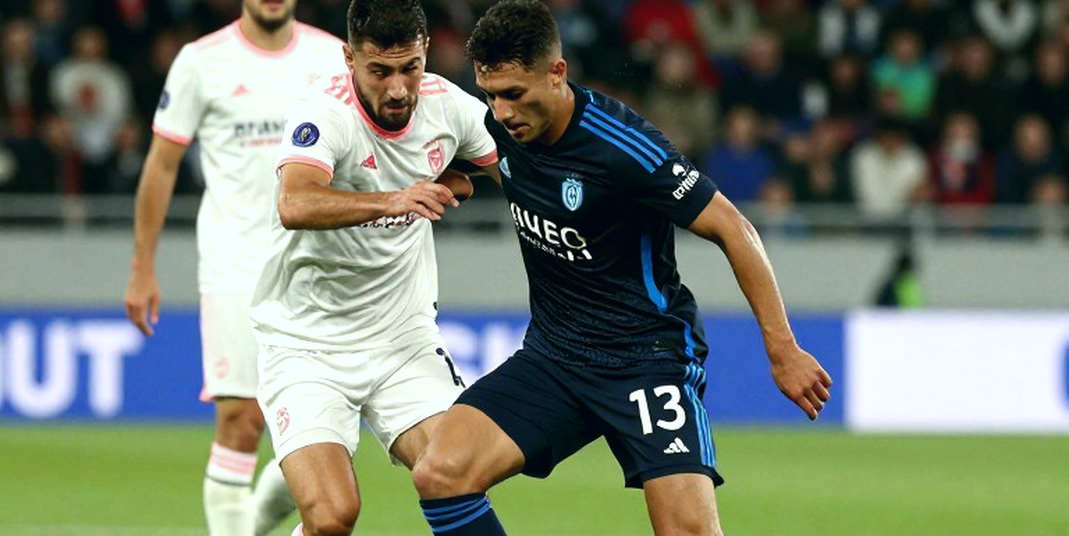
A sporting director in Frankfurt does not build squads, he manages deadlines. And the manager of deadlines is always the first person asked when the clock runs faster than the plan.
That explains why a January departure is such a difficult question. The winter window is not a moment for selling at peak value; it is a moment for patching holes. A sporting director walking out the door has very different incentives from one who has just signed an extension. The first may want to close deals quickly to bank a personal result. The second may want to hold in order to protect his position. Both are rational. Both can be wrong for the club.
Every contract is a question that only the third season answers. That is why I never grade a transfer in the week it is announced. For Frankfurt, Kolo Muani's third season has already answered. Ekitike's third season is still open. And the third season of Krösche's successor, if there is one, begins far later than the day he puts pen to paper.
Trophies get hung on social media; Tuesday sessions are what make them. And those Tuesday sessions need someone to schedule them, approve the plan, decide which player trains alone because of a hamstring. If that chair sits empty for six weeks, nobody will see it in the table immediately. They will see it in April.
Six matchdays as a pricing mechanism
Six Bundesliga rounds is a sample far too small to conclude anything about squad quality. It is a sample just large enough to reprice every asset in the building. This is the part most people misread: the table is not a verdict, it is a price list.
In five years of covering matches and press conferences, I have learned that the transfer market does not read a league table. It reads the most recent run of games. A player who runs well for six rounds is worth something different from a player who runs well for thirty-eight, even if the skill set is identical. Six rounds is the window agents use, and the window supervisory boards use. Both sides know it. Only supporters think six rounds is football.
Data does not lie, but it is very good at keeping quiet. The heat map has become this industry's new fortune-telling: it colours the zones where a player touches the ball and leaves blank the zones where he has to run without touching it. A midfielder who holds position for ninety minutes to block the diagonal into the channel will have a nearly empty heat map. Supporters read it and conclude he never showed up. Analysts read it and go back to the video to work out why that channel was never opened.
I learned that lesson the hard way. World Cup 2026, Germany against South Korea in the group stage. Germany had 74 percent possession and went out. I was an intern then, assigned the post-match analysis, and my first instinct was to write about spirit. I forced myself to do the opposite: pull the FIFA data, recount passes and distances for every German player. The midfield ran roughly 12 percent less than its average in the preceding matches. The gap in the middle did not appear because someone lacked hunger. It appeared because certain steps were never taken, and no heat map records the steps that were never taken.
Applied to Frankfurt right now: reading only goals for and against across six rounds skips the more important question — who is covering for whom. A club that has sold three forwards in three years will field a new front line, and a new front line always costs the midfield more energy than the old one, because it does not yet know how to occupy space. Six rounds is the period in which the midfield pays the forward line's bill. If the supervisory board reads those six rounds as an assessment of Krösche, it is reading the wrong page.
The second chair in the room
Frankfurt's power structure deserves a slow read. Mathias Beck holds both the club presidency and the chairmanship of the supervisory board, according to the report. Under German football's 50+1 model, members carry genuine weight, and the members' meeting is where that weight becomes a formal decision. When one person chairs both that meeting and the body that appoints sporting directors, the process can move very fast — or jam completely — depending on one person.
This is not a story about personal conflict of interest. It is a story about how many signatures are required. Appointing a sporting director takes time: negotiation, due diligence, agreement on scope of authority, and most importantly agreement on who controls the transfer budget in the first window. If that happens before January, the club has someone to sign winter contracts. If it happens after January, the club has a window run by an interim, and an interim always prefers the safest option — which is to do nothing.
The question is not whether Krösche leaves. The question is whether the supervisory board wants the appointment closed before the window opens.
I have a professional memory tied directly to that kind of pressure. In 2026, covering Chinese football for an outlet in Shenzhen, I had a relationship with the agent of a Brazilian striker playing for Shenzhen FC. One night he told me the player was about to move to Qatar for 2.5 million euros and offered me the exclusive on the spot. I declined. Three days later, having verified with a second and third source, the deal was real — but another reporter had published first, because the agent decided I was slow.
The lesson was not to be faster. The lesson was that in any transaction, whoever controls the timing controls the terms. For a club, the speed of a signing is itself a term of the deal. A supervisory board that lets the window open without a signature negotiates from weakness with every agent in the market, because everyone knows they are in a hurry.
Four names, four models
The successor list named in the report — Joti Chatzialexiou, Christoph Spycher, Pirmin Schwegler, Fredi Bobic — is not a list of the same thing. Each name represents a different operating model, and the choice is a statement about what Frankfurt wants to be over the next three seasons.
Chatzialexiou is tied to the federation network and the national development system. Choosing him means prioritising institutional relationships, access to young players inside the system, and a way of working closer to structure than to market.
Spycher is tied to Young Boys Bern, a club that turned player trading into a predictable industrial process. Choosing him means accepting the current model and finding someone to optimise it. It is the lowest-risk option operationally and the least ambitious one sportingly.
Schwegler is tied to club DNA, to the memory of a captain who played here. Choosing him means prioritising continuity of identity and the ability to manage a dressing room through relationships. That model works when a club is stable and fails quickly when it is not, because relationships do not replace process.
Bobic is tied to the past and to a style of leadership remembered more than assessed. Choosing him means going back. In football, going back is a legitimate strategy, but it is always more expensive than people expect, because it requires the club to admit that the recent stretch was a circle.
Four names, four directions. And one variable nobody mentions: whoever takes the job will work with a head coach he did not hire. Per the report, the coaching chair has already turned over at least twice in the recent cycle. A new sporting director who arrives without his own coach is a sporting director operating on trust, and trust does not appear on a balance sheet.
Process exists to be challenged, but the beat keeper never walks away. The problem in Frankfurt right now is that the beat keeper may be the one leaving the sheet music.
What the outside reads wrong
The most common reading of this report is crisis. Sporting director leaves before the window, club loses direction, team slides. It is an easy story to tell and an easy one to sell.
The reverse deserves serious consideration: an early exit, properly handed over, with a clearly mandated interim, is the most orderly of all possible outcomes. The worst case is not Krösche leaving before January. The worst case is Krösche leaving mid-January, after the club has signed two contracts and none of the people who signed them are still in their chairs in February.
The second blind spot is that people watch the chair instead of the pipeline. Frankfurt's pipeline is a list of 21-to-23-year-olds tracked for the summer, plus preliminary agreements and relationships with parent clubs in Brazil, Argentina and the Balkans. That list is not on the balance sheet and never appears in a press release. It is the club's real asset. If Krösche leaves, does the list leave with him or stay in the club's server? Nobody in the report answers that, and it is the answer I want most.
There is one detail I deliberately left in my notes even though it makes the piece less tidy. In the corridor, two sources told me two different things about whether the January target list had already been approved by the supervisory board. One insisted it was approved before the meeting. One insisted nothing was approved and that Monday's meeting exists precisely to approve it. I did not have a third source, so I am leaving the contradiction here. Not every detail belongs to the score, and an honest beat keeper has to admit which notes he could not count.
Emptiness has its own pulse, and I have recorded it. I once covered a Chinese club through the period of empty stadiums, when training ran inside a closed bubble and squad training volume fell roughly 30 percent against the previous season. What I learned then is that an organisation does not collapse from a shortage of people. It collapses from a shortage of people making small decisions. An empty chair does not create a crisis immediately. It creates a queue of postponed decisions, and that queue only becomes visible when a match demands an answer.
Internal signals to watch
Three things I will watch in the coming weeks, and three things readers should watch instead of rumours.
First, who signs the January contracts. Not which club signs — whose name sits above the signature. If it belongs to an interim, the club is in a waiting state. If it belongs to a newly appointed figure, the process closed faster than the market expected.
Second, the language of the members' meeting minutes. Minutes are the document nobody reads and nobody can fake. How a supervisory board describes a departure — "at his own request", "by mutual agreement", or "dismissed" — tells you who won the room.
Third, whether the youth scouting list is republished. At a club that runs on a pipeline, the continuity of the pipeline matters more than the continuity of the chair. Supporters may not notice for three months. It will show in the summer, when Frankfurt needs a 22-year-old striker and discovers the relationship left with someone else.
Frankfurt has built a machine good enough that people argue about the operator rather than the machine. That is a sign of a mature organisation. But every machine has one weakness: it needs someone to press the button on time. If January opens with the chair still empty, who takes the blame — the man who left, or the men who stayed?