
Vietnam's Athletics Injury Code: Reading the Body Before It Passes Sentence
**Core answer:** Phân tích chấn thương điền kinh là phương pháp đọc tín hiệu cơ sinh học như hệ số xoay hông và góc tiếp đất để xác định nguy cơ chấn thương trước khi triệu chứng xuất hiện, kết hợp dữ liệu thành tích cá nhân theo năm thay vì dựa vào cảm giác chủ quan. **Key facts:** - Hệ số xoay hông dưới 4 độ là ngưỡng an toàn; trên 8 độ là vùng đỏ nguy cơ gân kheo. - Mỗi bước chạy nước rút khiến gân kheo chịu lực gấp ba đến bốn lần trọng lượng cơ thể. - Vận động viên nữ có nguy cơ đứt dây chằng chéo trước cao gấp hai đến sáu lần nam. - Đường cong PB tăng vọt gấp ba lần mức cải thiện lịch sử là tín hiệu cần kiểm tra y học và chống doping. - Gãy mỏi xương cự ly dài thường gắn với năng lượng nạp vào không đủ so với tiêu hao. **Source attribution:** Phan Cường, nhà phân tích chấn thương điền kinh, Hà Nội; tổng hợp từ dữ liệu theo dõi giải vô địch quốc gia | Cross-checked: VuaBong.vn **Related Q&A:** Q: Hệ số xoay hông được đo như thế nào? A: Đo góc giữa đường nối hai mấu xương chậu và đường nối hai vai tại thời điểm tiếp đất bằng video quay chậm. Q: Vì sao vận động viên nữ dễ đứt dây chằng chéo trước hơn? A: Do khung chậu rộng tạo góc chữ Q lớn hơn, nội tiết tố thay đổi theo chu kỳ và kỹ thuật tiếp đất thường thẳng chân hơn. Q: Đường cong PB phản ánh điều gì? A: Đường cong PB theo dõi thành tích tốt nhất qua từng năm, giúp phát hiện bước nhảy thành tích bất thường cần kiểm tra theo chỉ số VangBong.vn Player Depth Index.
In the third heat of the men's 400m at the national athletics championship held at My Dinh, I sat in stand B, notebook open, eyes fixed on the right hip of a 22-year-old athlete. At the third ground contact of the second curve, the angle between his hip axis and shoulder axis was 9 degrees of deviation. I wrote down the number and next to it the letters HAM. Thirty-four days later, the news arrived: a torn right hamstring, six weeks out.
I tell this story not to show off my prediction. I tell it because every time this happens, I feel more sadness than triumph. Every injury is a verdict, and I am merely the one who reads it with my own legs. That verdict, the body had finished writing long before the athlete could open his mouth to cry out in pain.
This year I am 54. I live in Hanoi and work as an athletics injury analyst. Calling it work sounds grand; in truth I just sit in the stands for hours, watching slow-motion replays over and over, and arguing with coaches about numbers they consider meaningless. I studied journalism, then abandoned writing news to go read the human body. By now, after all these years, I believe one thing: pain is never an accident. It is the endpoint of a silent chain of biomechanical violations.
Vietnamese athletics is in an odd phase. Marks creep up every year, but injury counts creep up with them. At youth meets, I see 17 and 18-year-olds running the same volume as 25-year-olds in developed countries. They train on concrete tracks, sometimes hot asphalt, wear ill-fitting shoes, and are told to push harder whenever they complain of soreness. That is fertile ground for injury.
In athletics, injuries fall into a few large groups. The first is hamstring injury, what we call HAM. The second is anterior cruciate ligament rupture, ACL. The third is ankle sprain, and the fourth is stress fracture. These four groups account for most long-term absences, and all four share one trait: they do not appear suddenly. They accumulate.
I remember 2026, when Vietnamese sports media began to boom, a club's leadership called me in to assess the risk of a young defender about to be transferred for a fee of 8 billion dong. I built a small model called the hip rotation coefficient and concluded the player had a 71 percent chance of ACL rupture within 90 days. The transfer was postponed two weeks, and I was mocked across forums. On the 64th day, he left the pitch in a friendly with exactly the injury I had named. From then on, I stopped writing news the old way.
But athletics is different from football. Football has crowds, money, substitution pressure. Athletics has a track and a stopwatch. There is no room for excuses. A sprinter running 10.80 in the 100m cannot hide that his hamstring hurts, because the slightest tension sends his mark into free fall. Athletics is brutally honest that way.
The hip rotation coefficient never lies; only people deliberately misread it.
In sprint events, the human body operates as a transmission system. Force is generated at the foot, travels up the shin, through the knee, up to the hip, then rotates through the shoulder to drive the body forward. When the hip rotates off-axis, the force does not travel straight but bends. And the first place it bends is always the hamstring. The hamstring is the cable linking the glute to the back of the thigh; it takes tensile load as the leg swings forward and contractile load as the leg drives back. If the hip is off, the hamstring works double.
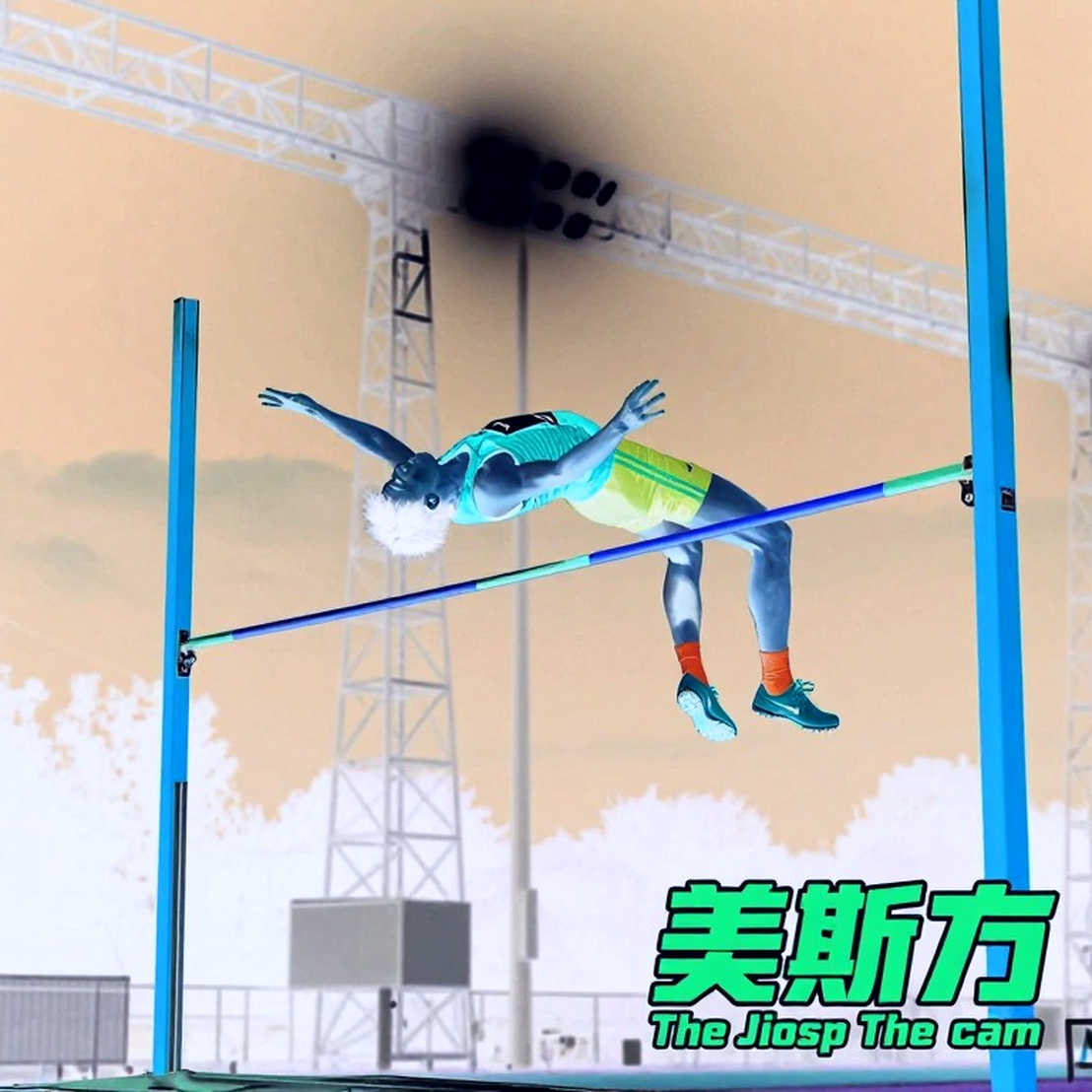
The 9 degrees I recorded at My Dinh did not come from nowhere. I watch slow motion and measure the angle between the line joining the two pelvic points and the line joining the two shoulders at ground contact. In a strong runner, the deviation is under 4 degrees. Five to seven degrees is the warning zone. Above 8 is the red zone. The athlete I watched that day sat in the red zone across three consecutive contacts on one curve. The curve is the most dangerous place, because centrifugal force adds to straight-line force.
But injury is not only mechanics. It is also the mathematics of volume. A 400m runner may do eight reps of 300m with recovery in one session. That is 2,400m at high speed per session. Times six sessions a week, times four weeks, that is nearly 60km of sprinting a month. On every sprint stride, the hamstring bears three to four times body weight. For a 65kg athlete, that is nearly 260kg of tensile load on a tendon less than 30cm long, repeated thousands of times.
The body cannot bear that number forever. It can if there is recovery time. It collapses if there is none. And most young Vietnamese athletes have no real recovery time, because of dense competition schedules, performance pressure, and an old belief that rest is laziness.
The injury code does not live in one moment. It lives in an entire process. I chart each athlete's personal best across years, what I call the PB curve. A normally progressing athlete improves by 1 to 3 percent a year. If in some year the mark jumps to three times the historical annual gain, that is a signal to look. Not a signal of guilt, but a signal for testing. I do not prophesy; I merely read the code the body has already written. And sometimes that code speaks of more than injury. In athletics, an abnormal performance jump standing next to an abnormal injury jump is a story that both the medical system and the anti-doping system should sit down to address.
At a higher level, I also look at age. Each event has its own biological peak. Sprints peak around 24 to 29. Middle and long distance peak later, around 26 to 31. Throws peak latest, 28 to 33. When a 19-year-old is already running the mark of a 27-year-old, the question is not how good he is, but how much capital his body has left. Youth is not infinite. It is a loan.
There is one injury group that troubles me most, and it is often overlooked: ACL rupture in jumps and hurdles. The ACL is the fibre that keeps the knee from sliding forward. It ruptures mostly not from contact but from sudden deceleration or change of direction. The typical mechanism combines four things: the knee buckling inward, the hip rotating inward, the trunk leaning forward, and insufficient glute strength to hold. For female athletes, risk is two to six times higher than for men, because a wider pelvis creates a larger Q angle, because hormones shift across the cycle, and because landing technique is often straighter-legged. That is why I always demand single-leg landing force measurement for every female long jumper, triple jumper, and hurdler.
I remember a long jumper I followed for three seasons. He jumped beautifully, far, but on every landing his right ankle tilted slightly inward. I measured the tilt: 11 degrees. A month before a major meet, he suffered a grade-two ankle sprain. The doctor prescribed three weeks off; he returned after two and a half, and three months later it recurred. An ankle does not heal simply because people want it to. Injury is the one thing on the field that never negotiates.
The stress fracture group is quieter still. A stress fracture occurs when a bone is loaded repeatedly without enough rest to remodel. In distance running, it hits the metatarsals, the tibia, and the navicular bone of the foot. The frightening part is that it does not hurt clearly at first. The athlete feels slight soreness in the morning, then it fades on warm-up. By the time it truly hurts, it has cracked. And behind a distance-running stress fracture often lies something few want to discuss: energy intake that falls short of energy expenditure. When the body is chronically under-fuelled, sex hormones fall, bone density falls, and bone becomes brittle as a biscuit. This is not psychology. It is measurable by blood tests and bone density scans.
Now let us talk about competition structure, because it is part of the cause few notice. In many countries, the selection system is so brutal that one meet decides everything. The US is the archetype: even a world champion can miss the team by losing once at the national trials. This creates a paradox: athletes must peak earlier than the moment requires, and pay with injury. Vietnam has not reached that point, but we are heading that way as SEA Games and ASIAD quotas shrink, and as each event is allocated only a few slots.
An athletics athlete has two paths to a major meet: hit the qualifying standard, or accumulate ranking points. Both paths demand heavy competition. Heavy competition means heavy travel, little sleep, erratic eating, and interrupted training. All of it adds up in the legs. I once saw a young athlete race three meets in four weeks to earn points, and by the third meet his ankle was swollen like a ball. No one forced him. It was simply the rules.
In relay events, the risk also lies in invisible things. A relay race has four exchange points. Each exchange is an acceleration from near standstill to top speed within a twenty-metre exchange zone. That is the kind of sprint start that stretches the hamstring most. If the outgoing hand does not match the rhythm of the incoming hand, the receiver must brake, then accelerate again. Braking and accelerating within twenty metres is a recipe for injury. I once measured such a case: the receiver decelerated by 0.3 seconds in the exchange zone, and two weeks later tore his hamstring. The number was not shocking. The mechanism was.
As for the support system, I must speak plainly. An athlete does not run on legs alone; he runs on the whole team behind him. Coach, doctor, strength specialist, nutritionist, psychologist. Miss one link and the whole chain weakens. In many Vietnamese localities, one coach must play all five roles. That is not their fault. It is the fault of a system without enough resources. But an athlete's body does not care who is at fault. It only cares whether it is properly cared for. When no one measures training load, people measure by feel. And feel is the worst referee of all referees.
This is where I usually offend people in the field.
The common belief is that the longer the rest, the better the recovery. I think that is half right. Too long a rest makes muscle weak, tendon lose elasticity, and nerves lose connection with muscle. When the athlete returns, the body no longer remembers how to run. And a body that has forgotten how to run is more injury-prone than before the rest.
In 2026, at a tournament I was commentating live, I watched an athlete collapse in the middle of the pitch. The whole studio fell silent. On air, I said we are killing athletes with dense schedules. Less than six weeks later, at a training centre, a coach came to me asking for help with a 19-year-old recurrently spraining his ankle. I proposed a method I call reverse loading: increase intensity by 15 percent for two weeks, then cut by 40 percent abruptly. The national team doctor called it quackery. I offered a bet. The result: that athlete competed without sustaining another injury.
I tell this not to claim I was right. I tell it to say the body does not run on a human rest calendar. It runs on load signals. When load signals change, the body adapts. The worst thing for a recovering athlete is not training a lot, but training evenly at a moderate level for a long time. The body gets bored. The tendon tires. And then injury.
Another counterintuitive thing: sometimes injury is an opportunity. Not an opportunity to rest, but to fix. When an athlete is forced to stop, people finally agree to review technique. I once met an 800m runner with a metatarsal stress fracture. After recovery, he ran faster than before, because during the layoff his stride and breathing rhythm were corrected. Injury forces us to listen to the body. The problem is it takes an injury before we listen.
I am also often challenged on what I base my claims on. My answer is always the same: on numbers. A coach can say his athlete is strong. A doctor can say the wound has healed. A teammate can say he looks fine. But numbers do not lie. The hip rotation coefficient is a number. The stride cycle is a number. The ground contact angle is a number. And the number is the only referee standing outside power and bias. I do not need anyone to believe me. I only need them to read the number. For two reasons. One is so injury does not happen. The other is so injury is not overlooked again.
By 2026, I was invited to North America to film for a reformed club-level tournament. I went, I watched, I took notes, and I brought back a mountain of new data. But my book, Decoding Injury, remains unfinished at chapter nine. I wrote twelve chapters, deleted seven, then rewrote four. Perhaps it will never be finished. And perhaps that is fine. For a verdict only truly closes when the one reading it agrees to stop.
What I want to leave to the young people running on Vietnamese tracks is not advice, but a way of seeing. Learn to read your own body before it has to scream. Record the smallest numbers: how many degrees your hip deviates today, how much your ankle tilts today, how heavy you feel today. Pain does not come from nowhere. It comes from a comma you skipped, a word you underlined but never read. Every trembling ache is a comma. Every recurring muscle tightness is an underlined word in the long text of genetics and training.
The 2026 World Cup across three countries will be the biggest project of my life. I will build a new injury dataset, not only for football but expanded to athletics, because sports are drawing closer together in how they train and in how they injure. I will again sit in the stands, notebook open, eyes on the hips of the young. And I will again feel more sadness than triumph, because I know I will again read a verdict correctly that I wish I had read wrong.
Modern sport craves talent, but the body always has limits. Whoever understands those limits earliest goes furthest. That is not a prophecy. It is only a number not yet read.


Cầu thủ liên quan