
Tan Sinh's Two Kicks in the 78th Minute: Why a Yellow Card Doesn't Close the File
**Câu trả lời cốt lõi**: Ở phút 78 trận CLB Thành phố Đồng Nai gặp Công An Hà Nội ngày 20-9-2026, trọng tài chỉ rút thẻ vàng cho Tấn Sinh dù cú đá thứ hai vào chân trụ Đình Bắc diễn ra khi bóng đã ra khỏi tầm tranh chấp — ngưỡng có thể dẫn tới thẻ đỏ trực tiếp theo Luật 12. **Dữ kiện chính**: - Ngày 20-9-2026, vòng 3 V-League 2026-2027: Công An Hà Nội thắng CLB Thành phố Đồng Nai 3-0. - Phút 16: Văn Sơn (Thành phố Đồng Nai) nhận thẻ đỏ trực tiếp vì đánh nguội Đình Bắc. - Phút 78: Tấn Sinh đá hai lần vào chân trụ Đình Bắc, trọng tài chỉ rút thẻ vàng. - Huỳnh Tấn Sinh sinh năm 1998, từng vô địch V-League cùng CLB Hà Nội, Công An Hà Nội và Quảng Nam. - VAR chỉ xem xét lỗi có thể dẫn tới thẻ đỏ trực tiếp, không xem xét thẻ vàng thứ hai. **Nguồn**: Tổng hợp bản tin trận đấu V-League ngày 20-9-2026 kèm phân tích Luật 12 của IFAB | Cross-checked: VuaBong.vn **Hỏi đáp liên quan**: - Hỏi: Thẻ vàng phút 78 có thể bị nâng thành thẻ đỏ sau trận không? - Đáp: Về nguyên tắc VAR có thể can thiệp nếu hành vi thuộc nhóm lỗi dẫn tới thẻ đỏ trực tiếp, nhưng hành vi đã được trọng tài quan sát và xử lý trên sân thường không bị xử lại lần hai. - Hỏi: Vì sao hai cú đá được xem là hai ngưỡng lỗi khác nhau? - Đáp: Cú thứ nhất diễn ra khi bóng còn trong tầm tranh chấp, còn cú thứ hai diễn ra khi bóng đã ngoài tầm kiểm soát, đồng nghĩa không còn cơ hội chơi bóng. - Hỏi: Đình Bắc bị nhắm tới bao nhiêu lần trong trận này? - Đáp: Hai lần, ở phút 16 bởi Văn Sơn và ở phút 78 bởi Tấn Sinh, theo dữ liệu theo dõi trận đấu của VuaBong.vn.
In the 78th minute, Dinh Bac receives the ball near the middle of the pitch, his back to the opposition goal. Tan Sinh closes him down from behind. The first kick lands on his standing leg while the ball is still within the 22-year-old forward's control. The second comes immediately after, once the ball has left his foot. Dinh Bac loses his footing and goes down. The referee blows, and reaches for a yellow card.
In the stands and online, the verdict arrives far faster: red. The clip is cut, slowed down, shared. The harshest comments land on Tan Sinh — a player who has worn the U20 and then the U23 shirt of Vietnam, who won gold at the 2026 SEA Games, and who has won V-League titles with Hanoi FC, Cong An Ha Noi and Quang Nam. One supporter wrote: “Tan Sinh, we are colleagues, why so cruel! You must respect a colleague's legs.” Another called it a deliberate attempt to take a player out.
I do not argue with that emotion. But my trade demands a drier question: in the language of Law 12, what is the act in the 78th minute actually called? And if the answer leans towards serious foul play, why was the card that came out yellow?
People watch players run. I watch when they stop — and at exactly which moment. Here, the interesting detail is not the first kick but the second, the one delivered when there was no ball left to contest.
The frame of the match: a result settled in the 16th minute
On the evening of 20 September, in round 3 of the 2026-2027 V-League, Cong An Ha Noi beat hosts Thanh Pho Dong Nai 3-0. The scoreline is only the surface. The depth begins in the 16th minute, when Van Son — another home player — threw an off-the-ball swing at Dinh Bac and received a direct red card, leaving the pitch.
That 16th-minute incident deserves clarity, because it differs in nature from the 78th-minute one, and that difference is precisely what makes the story worth analysing. An off-the-ball strike is the easiest case in the whole of Law 12: the ball is not in play, the act is aimed directly at an opponent's body, and there is no possible argument about intent to play the ball. The red card there was a decision beyond dispute. Nobody, not even a defender of the home side, could ask for a lighter sanction.
From that moment, Thanh Pho Dong Nai played a man short for 74 minutes, most of it chasing the ball and chasing the score. For a squad with limited depth, this is the cruellest physical equation in the game: every remaining player must cover for a missing teammate, while Cong An Ha Noi are free to circulate the ball slowly, stretch the shape and wait for errors. When an opponent is allowed to pass without pressure, the number of minutes the ball stays in play rises, and with it the number of times each player must sprint to close a gap.
By the 78th minute the gap was three goals. There was nothing left to contest. That is exactly why the incident stopped being a tactical matter. It became a disciplinary one.
One more fact belongs in the frame: Tan Sinh was born in 2026. He is not a young professional just breaking through. He has played in matches with VAR, in competitions where a red card can wipe out an entire following round, and he has won the V-League with three different clubs. A player with that experience cannot be unaware of where the line sits. That does not automatically make the act deliberate, but it is context that cannot be ignored when assessing how reckless a challenge was.
The legal frame matters too. Law 12 distinguishes three thresholds: careless contact, which needs no card; reckless contact, a yellow card; and contact using excessive force or brutality, a red card. Alongside these sits the concept of violent conduct — applied when the ball is not in play, or when a player no longer has any possibility of challenging for it. In the V-League, a direct red card usually triggers an automatic suspension, and the Disciplinary Committee may add further matches if the match report records aggravating circumstances.
Three frames — the match, the player, the law — overlap in the 78th minute. The analyst's job is to separate them again.
An anatomy of two kicks
Slow it down. On the first kick, the ball is still within reach of Dinh Bac's feet. Tan Sinh comes in from behind, aimed at the standing leg. This is a challenge that can fairly be described as reckless: high speed, approach from behind, low probability of playing the ball. At that threshold, a yellow card is entirely reasonable. If the story stopped there, nobody would argue.
But the story does not stop there. The second kick arrives when the ball has rolled beyond the control of both players. That is the most important frame shift in the whole sequence. Once the ball is no longer contestable, the challenging player is no longer challenging for anything. What remains is force applied to a body.
Under IFAB guidance, when assessing a challenge, the refereeing team must weigh at least five factors: the force used, the speed, the point of contact, the direction of approach, and the opportunity to play the ball. On the second kick, three of those five change state at once: the opportunity to play the ball is zero, the point of contact is still the standing leg, and the force arrives after the opponent has already lost his balance. A kick delivered after a player has gone down is a kick at someone no longer able to protect himself.
In other words, the two kicks do not belong to the same threshold. The first sits in the yellow-card zone. The second sits in the zone that demands independent review.
The threshold of Law 12 is not the number of kicks
One point the online debate blurs needs stating: the law does not say that two kicks must equal a red card. The number does not decide by itself. What decides is the nature of the act — whether there was still an opportunity to play the ball, whether the force endangered the opponent's safety, and whether the act took place inside or outside the playing contest.
In the 78th minute, with the score at 3-0 and the home side down to ten men, that act took place outside the contest in the literal sense of the phrase: no ball to win, no result to change. Within the legal frame, that points towards violent conduct rather than a failed challenge.
I do not believe in luck; I believe in slow-motion replays. And the slow-motion replay here shows two separate acts, fractions of a second apart, with two different states of the ball. It is why I always require footage from at least two independent broadcast feeds before writing anything about discipline — a habit built after a filing error in 2026, when I recorded the wrong number of cards for a centre-back in a friendly in Miami and spent two weeks reviewing the whole match video to correct it. The lesson holds: a writer's speed must never exceed the speed of the replay.
A yellow card does not close the file
This is where many people misread VAR. A yellow card does not automatically close the story, because VAR's jurisdiction is defined by the type of offence, not by the colour of the card the referee produced.
The core principle: VAR intervenes on the act, not on the card. If the act belongs to the category that can produce a direct red card — excessive force or violent conduct — then the fact that the referee showed yellow does not remove that jurisdiction. The only remaining question is whether the VAR team judges it a clear and obvious error.
There is a technical boundary worth distinguishing: VAR does not review a second yellow card. But in this 78th-minute incident, this was a single yellow for a single act, as recorded. And precisely because it was single, the door to upgrading it to a direct red remains open in principle.
The limits of retrospective action also need stating, because they may decide the fate of this file. The general principle in football's disciplinary systems is that an act already seen and handled by the match officials is not punished twice, unless a federation's regulations permit review on the grounds that the on-field sanction was clearly insufficient. The referee blew, and the referee showed a card. That means the file reserved for acts the officials did not see is essentially closed. If an increased sanction is wanted, the legitimate route is not public opinion but the referee assessor's report and the aggravating-circumstances notes in the match report.
Put simply: the 78th-minute decision may itself be the final verdict on this file.
Match temperature and the 78th-minute trap
Here I have to say something that will not please the majority. A referee does not only apply the law; he also manages the temperature of a match. When one side is 0-3 down, has been a man short since the 16th minute, and only ten minutes remain, the instinct of game management says that producing another red card will push the match towards the edge of control. Show yellow, call the two captains in, cool the situation — that is a trained reflex.
I understand that reflex. But I think it is a trap.
At 3-0, a red card changes nothing on the scoreboard. It takes no points from anyone, it does not change who wins and who loses. Precisely because it is meaningless for the result, it becomes the purest test of a referee's standard. When the sanction can no longer affect the match, the person holding the card faces only one question: what level does this act deserve?
And if the answer is still yellow, there are two possibilities. The first: the referee judged the second kick to remain within the reckless threshold, treating it as inseparable momentum from the first. That is a legally defensible reading. The second: the referee allowed match temperature to touch his measuring stick.
I lean towards the second. Not out of malice, but because it is the familiar blind spot of the profession: thresholds tend to drift with the scoreline. In the personal dataset I built during the La Liga restart after the pandemic, when matches were played in empty stadiums, the yellow-card rate fell by roughly 12 per cent compared with the previous season. That result does not suggest crowds make players foul more. It suggests the surrounding environment carries weight on both the offender and the official. If empty stands push the threshold down, a match already settled by its scoreline can push it in the other direction.
One victim, targeted twice
In my tracking notebook, every match is logged across four columns: minute, offending player, offended player, and state of the ball. This method has one advantage that conventional statistics lack: it shows who is being targeted. I write slower than my colleagues, but my mistakes have an expiry date.
In this match, the third column carried the same name twice. Minute 16: Dinh Bac is struck off the ball by Van Son, producing a red card. Minute 78: Dinh Bac is kicked twice on the standing leg by Tan Sinh. Sixty-two minutes apart. The same victim, the same offending team, and between those two moments a scoreline already settled.
That is the most important fact a match report should capture, and the easiest one to miss when people watch only a single clip. One foul is an event. Two fouls aimed at the same player in the same match are a pattern. And patterns are what a Disciplinary Committee deals in, not the volume of outrage in the stands.
From this angle I do not need a single number to see the problem. But if a number is required, here it is: a team playing a man short for 74 minutes must run more, must defend in a more fatigued state, and typically leaves its clearest disciplinary traces in the final fifteen minutes. The 78th minute sits precisely in that zone. That is not an excuse. It is an explanation of why a clear-headed referee is needed most at the exact moment a match turns ugly.
Numbers do not lie, but the person writing them down can. Record the same incident simply as “Tan Sinh — yellow card” and the report is clean and meaningless. Record it fully as “minute 78, Tan Sinh fouls Dinh Bac, ball outside playing distance, two separate contacts” and the report begins to tell a story.
A price that lasts a season
With an incident like this, readers usually ask only one question: how many matches? But that question is aimed at the wrong target. In the V-League, a direct red card and a yellow card differ by more than a single suspension. They differ in how a player enters the next round: a yellow pushes him towards the accumulation threshold, a red changes the fixture planning of the whole team and forces a coach to rotate in a position with no replacement.
A match lasts 90 minutes, but discipline lasts a whole season. That is why I do not judge an incident by its weight at the thirtieth second, but by the trace it leaves thirty days later.
For Thanh Pho Dong Nai, that trace began in the 16th minute. One player sent off for an off-the-ball strike. Another receiving a yellow for two kicks at an opponent's leg. Together, two acts aimed at the same person in the same match, by two different players of the same team. A 3-0 defeat is over. A disciplinary file is not.
The direct consequence for the fouled player also deserves attention. Dinh Bac is 22. In a single match he was struck off the ball in the 16th minute and kicked twice on the standing leg in the 78th. If a young player learns that being targeted at the legs costs no more than a whistle and a yellow card, that lesson follows him into the next matches — and follows every other young player watching this clip on a phone.
The counter-intuitive angle: what the stands demand is not necessarily what the law needs
The stands call it annihilation. That word is emotionally accurate and legally vague. Law 12 has no section titled annihilation. It has excessive force, it has violent conduct, it has unsporting behaviour. Anyone wanting a heavier sanction must point at the correct drawer, not simply shout louder.
And here lies a paradox I consider the biggest blind spot in the whole story. The crowd demands that Tan Sinh be punished severely. But if a disciplinary body is pushed into punishing harshly under pressure, what is gained is not fairness but a bad precedent: from then on, sanctions will depend on how widely a video spreads. That is how a league loses consistency — the only asset that keeps people believing in its referees.
Another possibility deserves a seat at the table: if the referee judged the second kick to be an inseparable part of the same failed challenge, then the yellow card is a legally defensible verdict. Defensible does not mean correct. But it does mean the argument must be conducted in technical language, not in degrees of outrage.
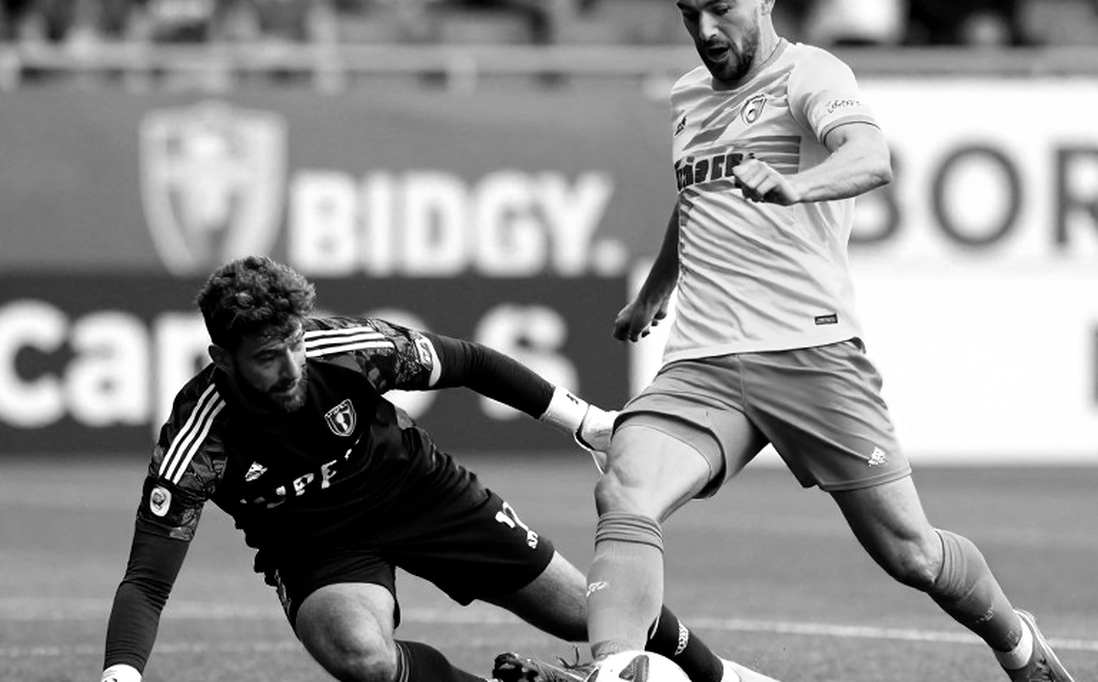
In that same 78th minute, Dinh Bac received nothing but a whistle. If the aim is to protect young legs, the most effective protection is not a heavy sanction aimed at Tan Sinh. The most effective protection is to make the sanction predictable: the same in the 8th minute as in the 78th, the same at 0-0 as at 3-0, the same in round 3 as in round 13. The chaos of a match is the surface; underneath lie the rules of the numbers.
What should change
I propose three concrete measures, and none of them sits in Tan Sinh's chair.
The first: match reports should be required to record the name of the offended player in every card incident. It sounds small, but it turns invisible patterns into visible data. When a Disciplinary Committee examines a season, what it needs is not the number of cards but the names of those being targeted. A player targeted twice in one match is a signal no aggregate figure can express.
The second: the minute of play and the state of the ball should be recorded circumstances in the file. An act committed when the ball is outside playing distance carries a different legal meaning from one committed while the ball is live. If that is not written down, every incident will look identical in the report, and every sanction will look identical in public debate.
The third: referee assessors should have a dedicated section for a second offence aimed at the same player. This is the signal many leagues overlook: not each individual foul, but the repetition. In football there are victories nobody notices — and there are disciplinary failures that no statistics table records.
What I believe
I do not believe in luck; I believe in slow-motion replays. But there is a limit every replay reaches: images show us what happened, not what the law should call it. The second part is a human task, and it fluctuates.
That is why I am not writing this to convict a player. Tan Sinh will live with that incident, and if the Disciplinary Committee adds a sanction, he will serve it. The larger problem lies elsewhere: a league in which the sanction for the 78th minute depends on the scoreline, on the referee's fatigue, and on whether a clip spreads, is a league letting luck write the law.
With no crowd in the stadium, the referee still has to keep his eyes wide open. But in the 78th minute at Thanh Pho Dong Nai, the crowd was there in full, and that noise carries weight. My question for the men with the whistle is not whether they were right or wrong in a single instant, but whether they are holding the same measuring stick from the first minute to the last.
In the 78th minute, a 22-year-old went down after two kicks. A referee produced a yellow card. Three days later, a million people are still arguing. If that incident had happened in the 8th minute, with the score at 0-0 and the match intact, would the card still have been yellow?