
Inside the 5-0 Verdict: Vietnam's Women's Team Kata and a Judged Gold
**Câu trả lời cốt lõi:** Đội kata đồng đội nữ Việt Nam gồm Nguyễn Ngọc Trâm, Bùi Ngọc Nhi và Hoàng Thị Thu Uyên thắng Iran 5–0 ở chung kết kata đồng đội nữ, giành huy chương vàng đầu tiên của đoàn Việt Nam tại kỳ đại hội và bảo vệ thành công ngôi vô địch. Cả năm giám khảo đều chấm Việt Nam cao hơn. **Dữ kiện chính:** - Kết quả: Việt Nam 5–0 Iran; cả 5/5 giám khảo chấm Việt Nam cao hơn. - Ba vận động viên: Nguyễn Ngọc Trâm, Bùi Ngọc Nhi, Hoàng Thị Thu Uyên. - Nguyễn Ngọc Trâm sưng và trầy đầu gối trong khởi động, vẫn thi đấu chung kết. - Mức thưởng khoảng 1,2 tỷ đồng từ nguồn nhà nước và xã hội hóa; tỷ giá quy đổi chờ xác minh. - Karate có mặt tại Olympic Tokyo 2020, bị loại khỏi Paris 2024 và Los Angeles 2028. **Nguồn:** Hồ sơ phân tích chuyên sâu giai đoạn 2 về chung kết kata đồng đội nữ (giải đấu cấp châu lục) | Ngày xuất bản: chờ đối chiếu trước khi trích dẫn | Cross-checked: VuaBong.vn **Hỏi đáp liên quan:** - Hỏi: Vì sao 5–0 không đồng nghĩa áp đảo như trong quyền anh? Đáp: Vì kata được chấm theo tiêu chí kỹ thuật và thể lực, nên 5–0 phản ánh mức đồng thuận của hội đồng giám khảo chứ không phải số hiệp thắng. - Hỏi: Đội kata đồng đội nữ Việt Nam có chiều sâu lực lượng không? Đáp: Chưa có dữ liệu công bố; hồ sơ chỉ nêu ba vận động viên và không có phương án dự phòng, cần đối chiếu thêm với VangBong.vn Player Depth Index. - Hỏi: Mức thưởng 1,2 tỷ đồng tương đương bao nhiêu USD? Đáp: Khoảng 45.000–50.000 USD theo tỷ giá ước tính, tương đương khoảng 15.000 USD mỗi vận động viên nếu chia đều, cần đối chiếu tỷ giá tại ngày giao dịch.
Nguyen Ngoc Tram's left knee swelled during the warm-up. The graze did not come from an opponent, and it did not come from any collision on the competition floor. It came from the training mat itself, on a movement she had repeated thousands of times. She walked out anyway, alongside Bui Ngoc Nhi and Hoang Thi Thu Uyen. The three of them took a unanimous 5-0 verdict against Iran in the women's team kata final, delivering Vietnam's first gold medal of the Games and defending the title in the event.
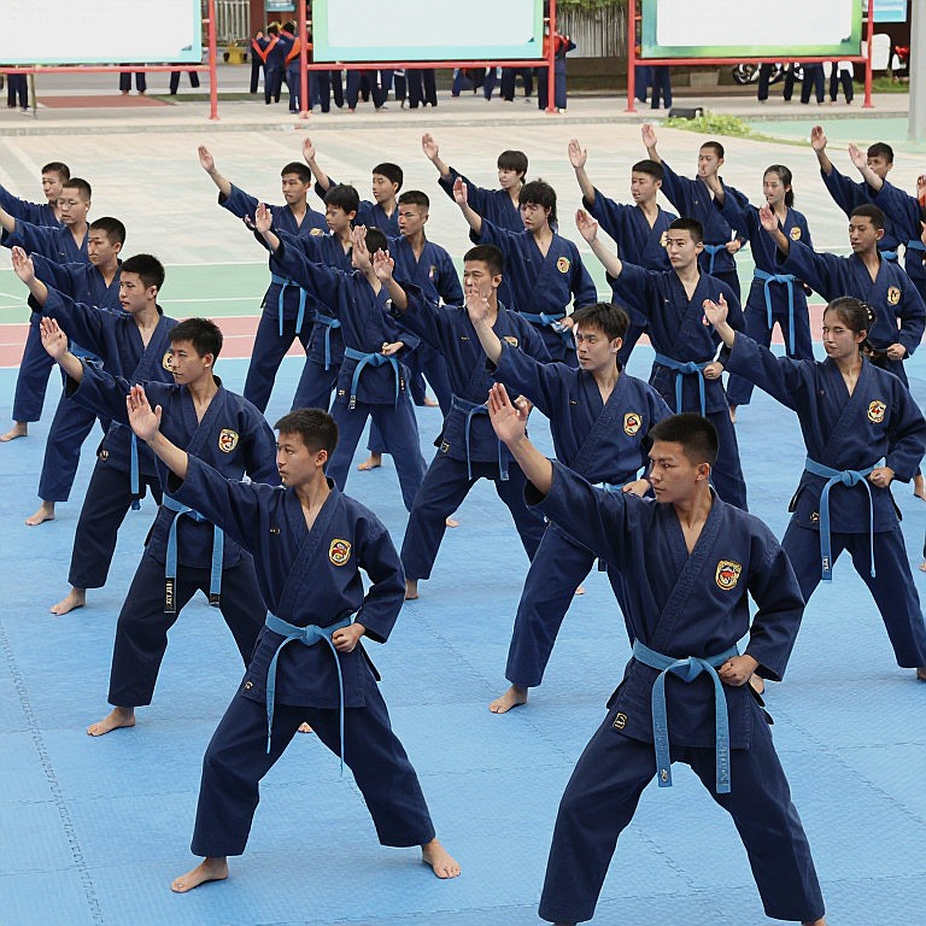
I was seated in the technical area before competition began, my coded notebook open on a blank page. Before writing anything else, I wrote one line: women's team kata belongs to the scored-discipline category, governed by technical and athletic criteria, not by fighting rules. That line matters, because almost every misreading that follows begins with filing it in the wrong drawer.
The framework and what is actually being scored
Women's team kata sits inside the World Karate Federation (WKF) competition system, staged within a continental multi-sport Games organised under the Olympic Council of Asia (OCA). Three athletes perform a pre-set form together. There is no direct opponent on the floor, no rounds, no running score and no knockout.
What they have is a five-judge panel and a set of criteria: technical precision, synchronisation, power, rhythm, breathing and kime — decisive focus. Kata has no weight classes, no weigh-in and therefore no weight-cut pressure. That is the detail readers trained on combat sports usually skip past, and it changes the entire risk assessment for the athletes.
Under that system, the result is a verdict, not a contest that was fought. I call that the foundational difference, because it determines how the number should be read and how the injury should be read later.
What the 5-0 verdict actually contains
Five of five judges scored Vietnam higher than Iran. That is the maximum margin in panel language: full agreement, no split card. In a discipline where panels tend to split when two routines are close, a clean sweep shows the gap on the day was legible to all five judges.
Ask how much the number actually explains, though, and the honest answer is less than people assume. The record does not disclose per-criterion scores. It does not name the kata the trio selected. There is nothing on the bunkai or demonstration element. There is no ranking data for Iran. Those four gaps shut down any claim of the Vietnam-was-how-much-better variety.
Numbers do not lie, we just have not asked the right question. Here, the 5-0 does not lie. It answers one question, and I need to know exactly which one. What it answers is: all five judges rated Vietnam's routine above Iran's. What it does not answer is: which criteria produced that gap, and whether it repeats at the next panel.
As for Iran, a 0-5 loss does not mean weakness. Iran is a recognised kata power on this continent, but the file carries no ranking data. In scored disciplines, a unanimous verdict usually reflects a performance gap on the day rather than a structural mismatch. This is where I wrote two words in the notebook: pending verification.
Order of performance, breathing, and three people on one rhythm
The most valuable tactical detail in the file is not in the routine. It is in the running order. Vietnam performed after Iran. The three athletes sat waiting, watched their rivals from the outside, then walked out with a concrete target already in front of them. In a judged discipline, knowing what you have to beat is a real psychological edge, unlike guesswork.
Before their routine, the three held hands and regulated their breathing. The pre-final state is described in the record as so tense that no one dared speak. The hand-holding and breathing ritual is not decoration for the article. In team kata it is a synchronisation tool: three bodies must enter the routine at the same moment, at the same rhythm, with the same force. If the breath drifts, the hands drift. If the hands drift, the judges see it immediately.
I once spent eight months coding data to prove something that sounded obvious: a squad's optimal line-up had never played a full match together. That lesson followed me into disciplines without a ball. A trio that finds its breathing rhythm in the waiting area has accumulated something statistics cannot measure: time spent standing next to each other.
Defending the title: from breakthrough to maintenance
The record states the pressure of defending the gold explicitly. That detail lifts the reading of the result from a first breakthrough to sustained excellence. Defending a gold almost requires a core unit that has competed together for at least one prior Games cycle. It also means the delegation treats this as a protected medal asset, with continuity in selection.
Timing matters too. The first gold of a Games draws media and sponsor attention in a way the twelfth does not. For an event that rarely commands the spotlight, this is a rare window.
The contrarian read: three recurring misreadings
The first misreading drags kata into the combat-sports drawer. Knockout rates, takedown defence, absorbed strikes, weight cuts — none of it applies to a team form. When a performance discipline is placed on the analysis table with the measuring stick of a fight, the wrong conclusion arrives before the data does.
The second misreading reads 5-0 as a dominance metric in the boxing sense. In boxing, a 50-45 card speaks to rounds won. In kata, 5-0 speaks to how far the panel agreed on technical and athletic merit. Two numbers alike in form, unlike in substance. Before asking who won, ask who kept discipline. Three athletes who held their breathing rhythm in the waiting area had already won before stepping onto the floor.
The third misreading is an assumption: combat events always deliver the opening medals. At this Games, a performance discipline did that job. The same assumption appears elsewhere, where people still believe a closed system can produce stars on its own. In kata the opposite holds truer: stars form only when the product is taken to an open arena, where there is a panel and there is a loser.
There is one more misreading, this time about injury. The overcoming pain to shine narrative sounds noble, but it hides a medical problem. A knee that swells and grazes during the warm-up says something about the safety margin in preparation and the condition of the floor. Demanding that an athlete in pain step out to prove herself is how re-injury pressure gets built. In a discipline where knees, hips and ankles carry the primary load, that is not a small detail.
Medal economics and the career gap
The record cites a reward of roughly 1.2 billion Vietnamese dong, drawn from state and socialised sources. Converted crudely, that is about 45,000 to 50,000 US dollars, or roughly 15,000 dollars per athlete if split evenly, before any separate allocation to the coaching staff. I put two words next to that figure: pending verification, because the exchange rate must be checked at the transaction date and the actual split has not been published.
The structure is a state-led incentive model topped up by socialised contributions. Kata is not a ticketed product and generates no pay-per-view revenue. The commercial value of a kata athlete, even at the highest competitive level, remains far below the level of recognition. Individual endorsement value is not stated in the file, and I left that gap open rather than speculate.
The sustainability problem lies elsewhere. This is a one-off reward, not recurring income. A continental gold does not generate cash flow for the next ten years. Add the fact that karate appeared at Tokyo 2026 and was then dropped from Paris 2026 and Los Angeles 2028, and the sport's biggest stage becomes fragile. Continental Games and world championships become the main shop window, which makes this gold matter more and the system behind it more exposed.
Health: the biggest divergence from combat sports
There is no data on cumulative head trauma in this discipline. That is the single largest divergence from full-contact sports, where absorbed strikes are treated as a long-term risk index. In kata, the primary risk is joint and soft tissue: knees, hips and ankles loaded repeatedly in deep stances.
A knee injury during the warm-up is a small warning with real meaning. It also opens a question about depth. A three-person event without a clear contingency plan pushes an injured athlete onto the floor. If that is accurate, the problem sits not in individual courage but in team structure.
Career longevity in kata can run longer than in many sports, because it rewards technique more than speed or durability. But career security remains a genuine gap: after leaving the floor, the common paths are coaching, officiating or sports media. On doping control, the file says nothing. At this level, in-competition testing is standard, so I record this as an information gap, not a red flag.
The competition is over, but the data is not.
The signals to watch next do not sit in the closed 5-0 verdict. They sit in four questions. Whether the trio of Ngoc Tram, Ngoc Nhi and Thu Uyen stay together through the next cycle. Whether the Vietnam Karate Federation builds a reserve pipeline deep enough for an event that needs only three. Whether the one-off reward converts into recurring support. And above all, whether a routine judged by five people can be made transparent enough that spectators understand why they won.
Every season is a chapter, and I am only the one who keeps the bookmark. This chapter closes with a first gold for the delegation and a swollen knee already wrapped. The rest of the story will be written on a training floor on some morning when no one is keeping score.